
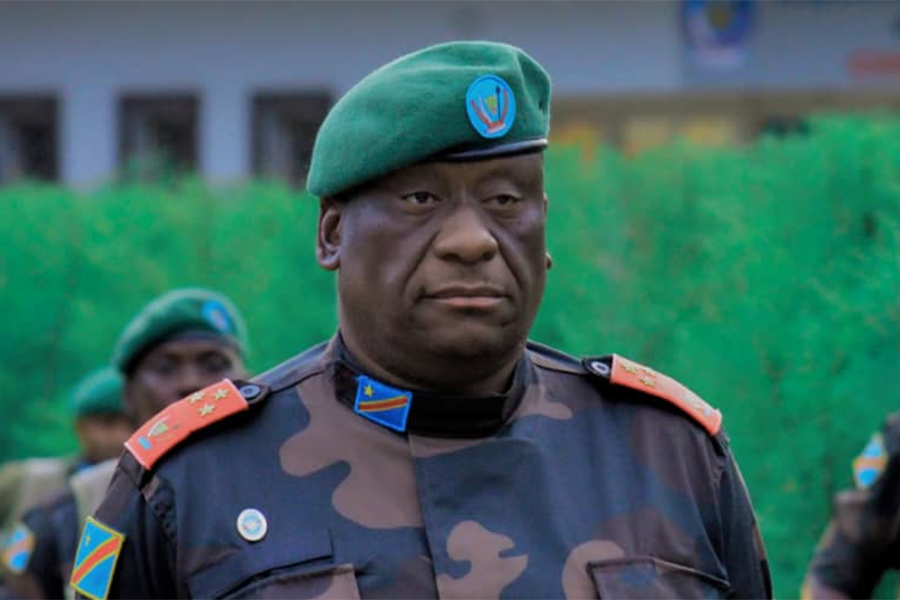
President Félix Tshisekedi has removed Ituri military governor Lt Gen Johnny Luboya Nkashama, ending one of the most scrutinised military administrations under the state of siege and ushering in new leadership as the province grapples with both worsening insecurity and a rapidly spreading Ebola outbreak.
In a presidential decree read on state broadcaster RTNC on Friday, Tshisekedi appointed Maj Gen Gaby Kasongo Mulumba Batoka as the new military governor of Ituri, replacing Luboya, who had served since the state of siege was imposed in May 2021.
No official explanation was provided for the change.
However, Luboya's departure comes amid friction with Uganda's military engagement in Ituri Province under the joint Operation Shujaa engagement against ADF and other rebels, as well as growing concern over the deteriorating security and health situation in the northeastern province.
In April 2025, Chief of Defence Forces General Muhoozi Kainerugaba publicly described the governor as "very toxic" and accused him of obstructing cooperation between the UPDF and Congolese authorities.
Muhoozi would later threaten to withdraw troops deployed between Lubero in North Kivu and Mahagi in Ituri over the strained relations with Luboya.
The tensions stemmed largely from disagreements surrounding Operation Shujaa, the joint UPDF-FARDC offensive launched in 2021 against the Allied Democratic Forces (ADF).
Luboya's administration insisted that Ugandan troops operate strictly within agreed parameters and reportedly restricted access through some border points, moves that generated friction with Kampala despite continued support from Kinshasa.
Relations deteriorated further in December 2025 when a security incident in Djugu exposed growing mistrust between forces operating in the province.
The UPDF said its troops came under attack from armed militants suspected to be rogue FARDC elements linked to the CODECO militia after Ugandan soldiers intercepted suspected insurgents.
Congolese accounts, however, alleged that fighting erupted after FARDC personnel attempted to secure the release of rebel elements detained by the Ugandan forces.
The competing narratives highlighted the fragile nature of military cooperation in one of eastern Congo's most volatile regions.
Yet while Muhoozi's public campaign made Luboya's position increasingly uncomfortable, regional observers say the governor's greatest challenge may ultimately have been his inability to contain the multiple crises unfolding simultaneously in Ituri.
Five years after the state of siege was introduced, armed groups remain active across large parts of the province. CODECO, the FPIC and the ADF continue to stage attacks despite sustained military operations, raising questions about the effectiveness of the extraordinary security measures that placed military officers in charge of civilian administration.
At the same time, Ituri has become the epicentre of the latest Ebola outbreak, with the highest concentration of confirmed cases reported in Bunia, Mongbwalu and Rwampara health zones.
From Ituri, the virus has spread into neighbouring North Kivu and South Kivu provinces and has crossed into Uganda, triggering regional concern over the possibility of wider transmission.
Health officials have faced enormous difficulties implementing containment measures and Gen Luboya's charges could not offer much security.
In several incidents during May, relatives of Ebola victims clashed with health workers and burial teams after authorities refused to release bodies for traditional funerals.
Angry residents attacked facilities at Rwampara Hospital near Bunia and demanded the return of deceased relatives, while similar confrontations were reported in Mongbwalu and during safe burial operations in Bunia.
The attacks exposed deep mistrust between communities and authorities and complicated efforts to break chains of transmission.
Public health experts warn that Ebola victims remain highly infectious after death, making safe and supervised burials one of the most critical components of outbreak control.
The repeated assaults on medics and burial teams have raised concerns that local authorities failed to secure community support for containment measures at a time when the outbreak was expanding beyond Ituri's borders.
The weak approach was placed squarely on Gen Luboya's shoulders since he was expected to have beefed up containment measures, including using military resources.
For Maj Gen Gaby Kasongo Mulumba Batoka, the challenge now extends far beyond replacing a predecessor. He inherits a province battling armed insurgencies, a fragile humanitarian situation, and an Ebola epidemic whose containment will require both effective security coordination and the restoration of public trust.
